
A root canal treatment is carried out when ‘the pulp’, the innermost part of the tooth becomes badly decayed or infected. The pulp is also known as the nerve of the tooth. If left untreated, the tooth will begin to die which could lead to infections, abscess and the loss of the tooth. To save the tooth, the infected pulp needs to be removed to prevent the formation of an abscess.
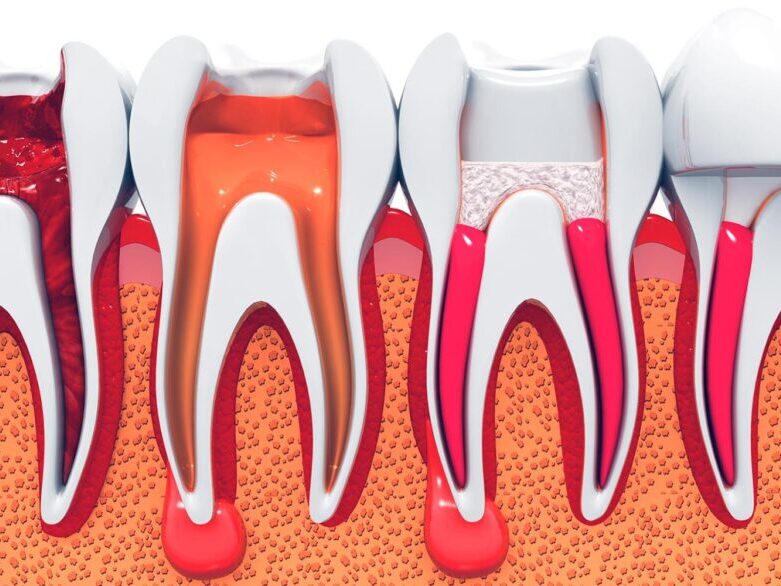
What is root canal treatment?
The tooth is made up of
- Enamel – The hard outer layer of the tooth. One of the hardest materials in your body!
- Dentine – This forms the core and gives the basic shape to the tooth which supports the enamel, it is softer than enamel but harder than bone.
- Pulp – Is the central part of the tooth which contains nerves and blood vessels and lies within the root canal.
The reason the pulp would die
- Caries aka Tooth Decay – If caries/tooth decay is left it will get bigger and bigger until it travels through the enamel and dentine down into the pulp chamber.
- Cracks – a Crack in an otherwise healthy tooth can travel into the pulp and disturb it.
- Trauma – A severe knock that affects the pulp of the tooth.
- Severe Gum Disease – The gum detaches itself from the tooth creating a gap between the tooth and the gum, bacteria then gets trapped causing an infection within the pulp chamber.
The symptons
- Pain – This can be anything form a constant dull ache to severe pain or pain only when biting.
- Sensitivity to hot or cold food/drinks. Temperature changes until trigger the infected pulp to ache and cause pain.
- A spot sometimes appears on the gum in the area of the infected tooth. This is commonly an Abscess where the collection of pus from the root tip is draining which will leave a bad taste in your mouth.
- Swelling in the gum area surrounding your tooth.
The team at Wainui Dental are highly experienced dentists that deal with sore teeth on a regular basis. We strive to ensure your procedure is as painless and possible. It is a common misconception that root canal treatment hurts – it commonly is carried out and is completely pain-free in almost all cases!
On your initial appointment the dentist will locate the offending tooth and take an x-ray in order to examine the roots of the tooth, to see how far the decay has traveled and if there is an abscess present.
the first appointment
- The dentist will give you a local anaesthetic to numb the tooth and the area surrounding it.
- Your dentist has to gain access to the pulp chamber.
- Once access has been gained to the pulp chamber, the dead pulp is removed from the root canals are cleaned and washed. This is to remove all the infection present in the tooth and surrounding areas.
- Once the root canals are cleaned the dentist will place a medication inside the tooth to help clear any bacteria. The tooth will be filled with a temporary filling and another appointment required or if the infection was not too serious, the tooth can be filled permanently and your treatment complete.
- The tooth may feel tender for a few days and you may need to take pain killers
- A course of antibiotics may be given to clear the abscess if it is very serious. Commonly treatment alone is enough to sort it out however.
if a second appointment is necessary
- You will be given a local anaesthetic to numb the tooth and the surrounding tissue.
- Your temporary filling will be removed.
- The dentist will continue cleaning out the canals using the same process as before. Once the canals are clean and dry they will be filled with a material called ‘Gutta Percha’ which is placed into the root canal to ensure a perfect seal.
- An X-ray is then taken to check that the canals have been filled completely.
- A permanent filling will then be put in place.
- Your dentist may advise you to have a crown placed on the tooth to strengthen it.
Benefits of Root Canal Treatment
Frequently Asked Questions
Common signs include toothache, sensitivity to hot or cold, swelling, or a spot on the gum near the affected tooth. However, only a dentist can confirm whether root canal treatment is needed, following an examination and x-ray. If you’re experiencing tooth pain, the team at Wainui Dental can assess your tooth and discuss appropriate next steps.
Root canal treatment is carried out under local anaesthetic to numb the tooth and surrounding area. Many patients report the procedure itself feels similar to having a filling. Some tenderness or discomfort is common for a few days afterwards, and your dentist at our Lower Hutt clinic can advise on appropriate pain relief if needed.
This depends on the individual case. Some root canal treatments can be completed in a single appointment, while others require two visits, particularly where there is a more significant infection that needs time to settle before the tooth is permanently filled. Your dentist in Lower Hutt will advise on the likely number of appointments after assessing your tooth.
If an infected or badly decayed tooth is left untreated, the infection can spread, potentially leading to an abscess, further pain, and eventual loss of the tooth. Root canal treatment is one option to address this; extraction is another. If you’re in Lower Hutt and concerned about a tooth, your dentist can discuss the options relevant to your situation.
This depends on the tooth and the extent of the damage. Your dentist may recommend a crown to help strengthen and protect a tooth that has had root canal treatment, particularly for back teeth that experience greater biting force. This will be discussed with you as part of your treatment plan.
It’s possible for reinfection to occur, for example if the seal is compromised, if new decay develops, or if the tooth is cracked. Maintaining good oral hygiene and attending regular dental check-ups in Lower Hutt can help your dentist monitor the tooth over time.
Both root canal treatment and extraction are recognised ways to manage a badly decayed or infected tooth. Root canal treatment aims to retain your natural tooth, while extraction removes it. The most suitable option depends on factors such as the extent of damage, the tooth’s position, and your individual circumstances — your dentist can talk through the pros and cons of each with you.
Most people return to normal activities the same day, though the tooth may feel tender for a few days, particularly when biting. Recovery time can vary depending on the severity of the original infection and individual healing.
Root canal treatment can be carried out on both front and back teeth, though back teeth (molars) have more root canals and can be more complex to treat. The dentists at Wainui Dental in Lower Hutt will assess your specific tooth and explain what’s involved before treatment begins.
Your first appointment typically involves an examination and x-ray to assess the tooth and surrounding bone, followed by treatment under local anaesthetic if you proceed on the same visit. The dentist will talk you through what to expect at each stage. At Wainui Dental, we aim to keep you informed throughout so you know what’s happening and why.